Uncomfortable Conversations? The Cameron Citizen-Observer Can't Even Start One
Heath Gilbert | Breach Holder | February 1, 2026

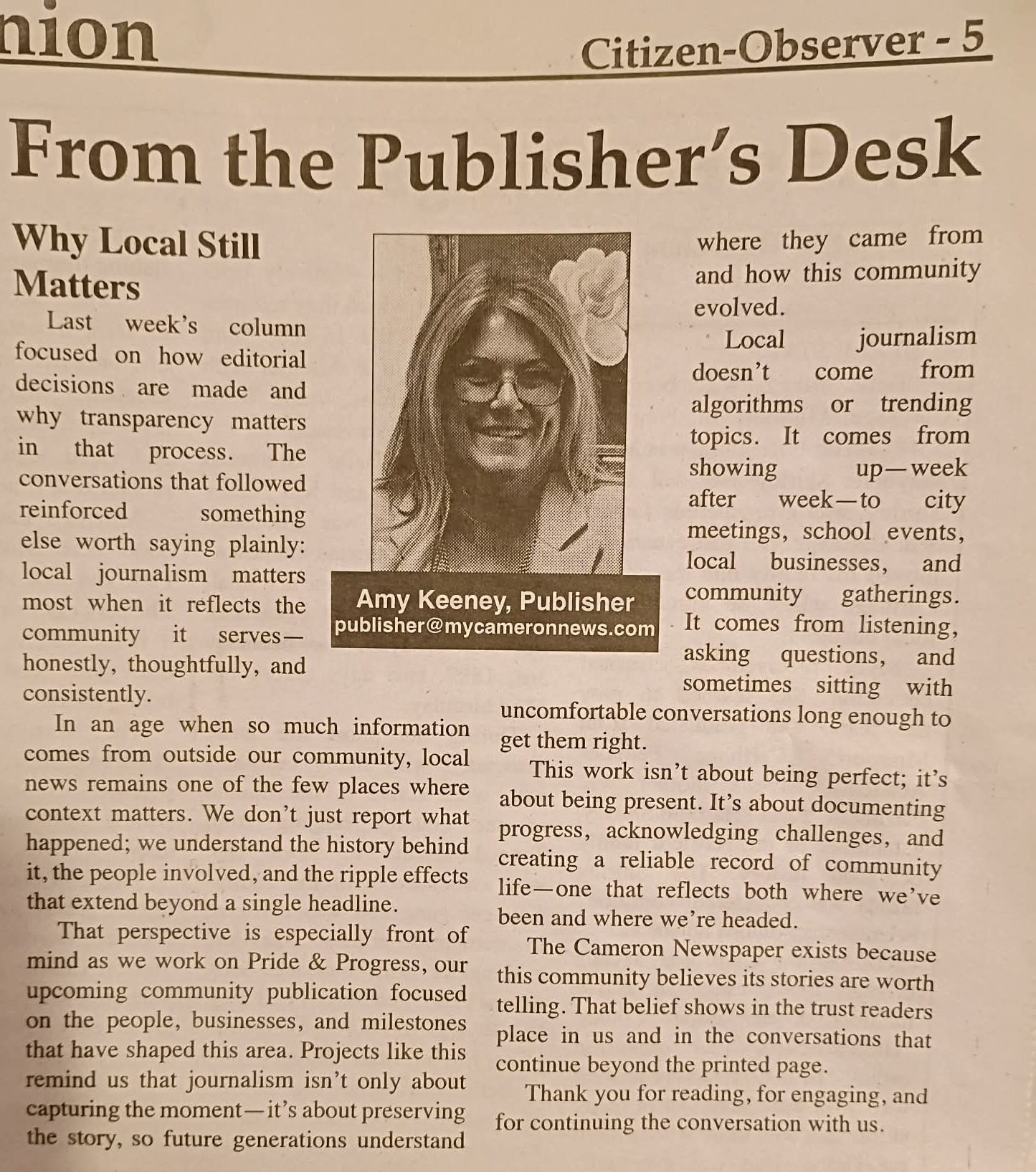
Amy Keeney, publisher of the Cameron Citizen-Observer, wrote something in her latest “From the Publisher’s Desk” column that stopped me in my tracks. Not because it was profound. Because it was almost comically ironic.
She wrote that local journalism doesn’t come from algorithms or trending topics. It comes from showing up week after week to city meetings, school events, and community gatherings. It comes from listening, asking questions, and—her words—”sometimes sitting with uncomfortable conversations long enough to get them right.”
I read that twice. Then I laughed. Then I started writing this article.
Because I have spent three years doing exactly what Amy describes. Three years of showing up. Three years of asking questions. Three years of sitting with uncomfortable conversations that nobody at the Citizen-Observer will touch. And the paper she publishes has systematically refused to cover the stories that come out of those conversations.
So let’s have an uncomfortable conversation about what’s actually happening in Cameron journalism. Amy opened the door. I’m walking through it.
What Amy Says Journalism Is
Amy’s column is sincere. She genuinely seems to believe the Citizen-Observer fulfills the role she describes. She talks about documenting progress, acknowledging challenges, and creating a reliable record of community life. She says the Cameron Newspaper exists because the community believes its stories are worth telling.
Beautiful sentiment. Completely disconnected from reality.
Amy also writes about their upcoming publication called Pride & Progress, focused on the people, businesses, and milestones that have shaped Cameron. Projects like this, she says, remind them that journalism isn’t only about capturing the moment—it’s about preserving the story for future generations.
That’s lovely. But a publication celebrating local pride doesn’t replace the watchdog function that journalism exists to perform. You can document every milestone in Cameron’s history and still fail the community by refusing to report what’s actually happening at the school district your readers fund with their tax dollars.
What the Citizen-Observer Won’t Cover
Here’s the uncomfortable conversation Amy is so proud of facilitating—except her paper won’t have it.
A student was expelled for a year over an airsoft rifle. The school district issued a press release announcing a firearm on campus. It was a toy. The student told them immediately it was a toy. They expelled him anyway—365 days—while another student who allegedly made threats against the school received five days of in-school suspension. The father of the expelled student told me his son was “railroaded for a toy” and that “it boils down to I don’t have a well known name in Cameron.” The Citizen-Observer has not reported any of this.
Read the full story: Whatever Happened to the Gun? Cameron School District’s Pattern of Silence Continues
The school district deleted its social media accounts to escape accountability. After videos of board meetings reached over a million views—videos showing officials ignoring public questions, inconsistent policy enforcement, and refusal to address legitimate concerns—the district shut down Facebook and Instagram entirely. In the same announcement, they admitted in writing they are “strictly limited by law” from doing exactly what they’d been doing to critics on those platforms. That admission came just weeks after they banned veteran Vinzent Cooper from their Facebook page for 90 days for comments that constituted protected political speech. The Citizen-Observer did not report on Cooper’s ban. They did not report on the district’s admission. They did not report on the social media shutdown and its constitutional implications.
Read the full story: Running From Critics: Cameron R-1 Deletes Social Media After Viral Videos Expose Dysfunction
An incumbent school board member voted to ban her electoral opponent from school property through the election. Dan Landi, a declared candidate for the Cameron school board, had his ban extended from May 2026 to January 2027—a timeline that conveniently covers the April election and the swearing-in period. The vote was 6-0. One of those six votes came from Ann Clark, who is running for re-election against Landi for the very same seat. Clark also participated in the closed-session discussion about her electoral opponent before voting to ban him. The “violation” that justified extending the ban? A 19-second video Landi recorded while filing his candidacy paperwork, in which a district employee refused to accept a lawful Sunshine Law request. That video has garnered nearly 75,000 views because it shows exactly what it is: a public servant refusing to do her job. The Citizen-Observer has not reported on this vote, on Clark’s conflict of interest, or on what this means for Cameron voters in April.
Read the full story: Incumbent Votes to Ban Electoral Opponent from School Property Through Election Period
The school board violated the Missouri Sunshine Law in the same meeting where they demanded citizens follow their policies. At the January 20, 2026 board meeting, the board approved a contract with Bridges Legal Services that was never listed on the public agenda. Board President Andi Lockridge acknowledged it was a “late addition” emailed to board members during the meeting. They read it for approximately two minutes and voted to approve it. Zero questions were asked. This is the same Lockridge who, in August 2025, terminated Dan Landi’s public comment time because he wasn’t staying precisely on a noticed agenda topic—invoking the very Sunshine Law requirement the board itself violated weeks later. In that same January 20 meeting, Vice President Ryan Murphy told the public: “All we’re asking is for people to come in here and follow the policies within our buildings.” The Citizen-Observer has not reported on this Sunshine Law violation.
Read the full story: Do As We Say, Not As We Do: Cameron School Board Violates Missouri Sunshine Law They Claim to Understand
Why the Paper Won’t Print It
This isn’t a mystery. I documented the answer in December.
Two local newspapers faced financial pressure from an advertiser to stop covering school district problems. Jamey Honeycutt, who owned the Clinton County Leader at the time, refused. He published the stories anyway and ultimately sold his paper rather than compromise his integrity.
Mark McLaughlin, the Citizen-Observer’s editor, made a different choice. He admitted to me directly in an email: “I had a conversation with my publisher. There was a strong sentiment arising from the community that wanted this to go away. There was a veiled statement that not doing so would result in a loss of advertising revenue.”
The paper stopped covering school district accountability issues. That was well over a year ago. To my recollection, the last time the Citizen-Observer printed anything critical of the Cameron School District was November 2024—and even that was material I had provided to them.
Read the full story: Cameron’s Puppet Master
Now, here’s where I have to be transparent about what I know and what I don’t. I don’t know who this individual is. I don’t know his name. I don’t know exactly what his purpose is in interfering with the publication of legitimate news in Cameron. I can’t tell you with certainty why he’s doing it.
But I can tell you what I can reasonably assume based on the pattern we’ve documented.
This person—whoever he is—has to be grateful that everything I’ve written about over the past month hasn’t made it into the Cameron newspaper. The puppet master doesn’t want people concerned about what’s going on in the school district. He doesn’t want a challenge to the status quo. The way things are currently being run, the way decisions are currently being made—that arrangement benefits him, and he wants it to continue undisturbed.
And here’s where it connects directly to Amy’s column and to what’s coming in April: by not reporting the news, by refusing to have the difficult conversations Amy herself says we need to be having, the newspaper is willfully keeping the community uninformed about choices they’re going to have to make at the ballot box. Three school board seats are up in April. If the Cameron paper continues to ignore the documented failures, the constitutional violations, the selective enforcement, and the advertiser pressure that silenced coverage in the first place—then voters are going to walk into that polling place believing everything is fine at Cameron schools.
It’s not fine. And if the newspaper refuses to print these stories, the voters will never know. The puppet master gets exactly what he wants. The status quo continues. And there is no transparency or accountability at Cameron R-1.
Instead of Covering the School District, They Wrote About Me
When I submitted two letters to the editor citing documented evidence—including McLaughlin’s own email about advertiser pressure—the paper refused to print them. McLaughlin told me I have “sufficient platforms” elsewhere and that if I believe civil rights have been violated, I should take it to court.
So instead of reporting on constitutional violations, selective enforcement, and advertiser influence on coverage decisions, the paper decided to write about me. Twice.
First, McLaughlin published a piece explaining why he wouldn’t print my letters. Then, after I responded to that piece, he published a second column that spent 900 words on dog metaphors without addressing a single factual question I raised.
I asked him directly: which specific facts in my letters are false? His own email? Honeycutt’s published statement? Court records? The school district’s own press releases? He didn’t answer. He wrote about his dogs.
I documented both exchanges here, if you want to read them:
When the Watchdog Won’t Bark: The Cameron Citizen-Observer’s Abdication of Journalistic Duty
From ‘Bell Ringer with Receipts’ to ‘Can’t Be Trusted’: What Changed in 14 Months?
The Challenge to Amy Keeney
Amy, you wrote that local journalism matters most when it reflects the community it serves—honestly, thoughtfully, and consistently.
I’d like to challenge you on that. Not with venom. Not with anger. With the same sincerity you brought to your column.
You are the publisher. McLaughlin is the editor. Someone made the decision to stop covering school district accountability stories after advertiser pressure was applied. Someone decided that instead of reporting on a student expelled for a year over a toy, or a board member voting to ban her electoral opponent, or a Sunshine Law violation committed in plain view—the paper would write about me.
I don’t know if you’re the publisher McLaughlin referenced when he described the conversation about advertising revenue. I don’t know if you made that call. But you are the publisher now. You have the authority to decide what gets printed.
So here is my challenge: Name the puppet master. You know who threatened to pull advertising dollars if the paper kept running stories critical of the school district. McLaughlin admitted it happened. Honeycutt confirmed similar pressure existed at the other paper. You have access to the same information both of them have.
The community has an election in April. Three school board seats. Voters deserve to know who is using financial pressure to control what their newspaper reports—and who on the school board might be connected to that pressure.
You wrote that the Cameron Newspaper exists because this community believes its stories are worth telling. I agree. So tell them. The stories are there. The documentation exists. The uncomfortable conversations have been happening for three years—just not in your paper.
Start now. Before April. While it still matters.
Heath Gilbert is a U.S. Navy veteran and independent journalist covering government accountability in Cameron, Missouri. He is the publisher of Cameron School District Exposed and Breach Holder. He has documented Cameron R-1 School District board meetings since September 2022.